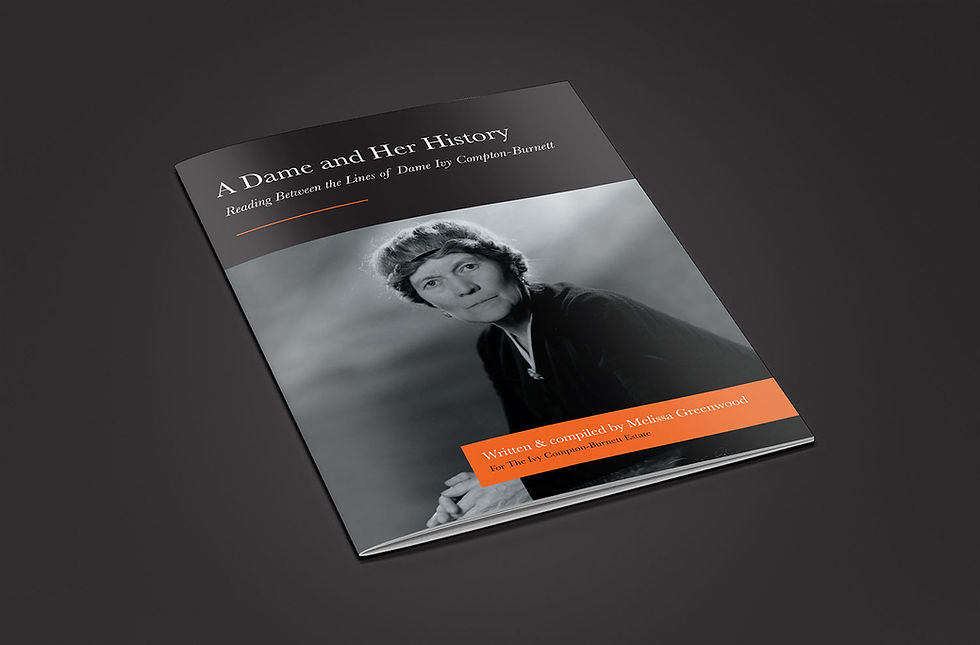
Article about Dame Ivy Compton-Burnett in the Italian newspaper La Repubblica
A conversation with Richard, heir to the great British writer who animated the London literary scene.

Translated text:
\
"I will tell you about my very wicked aunt Ivy, true rival of Virginia Woolf"
A conversation with Richard, heir to the great British writer who animated the London literary scene, and who will be remembered in Palermo today.
Ivy Compton-Burnett, "the great lady" (copyright Alberto Arbasino), didn't mince words. In the 1920s, she had met Virginia Woolf and asked if the Hogarth Press would publish her Masters and Servants. She was turned down; when Hogarth later realized its mistake—following Compton-Burnett’s breakthrough—and sought to become her publisher, she returned the favor. Relations between them turned frosty, with Woolf noting in her diaries the "pain" of the certainty that her own prose was "far inferior to the raw truth and intense originality of Miss Compton-Burnett." But who was Ivy—whose works are currently being republished in Italy by Fazi? Her nephew, Richard Compton-Burnett, reconstructs the extraordinary life of an author who demanded a room of her own, lived with a woman, and—through biting irony and unsurpassed dialogue—laid bare the hypocrisy of the English nobility and upper-middle class. The son of a cousin to whom the writer (who passed away in 1969 at the age of 85) bequeathed the rights to her works, he will appear on June 27 at 6:00 PM at the Fondazione Butera in Palermo. The foundation, in collaboration with the Estate of Ivy Compton-Burnett, had launched a competition dedicated to the author; the winner, Helen Charman of Clare College, University of Cambridge, will deliver a lecture at Palazzo Butera on the figure of the governess in Compton-Burnett’s novels. Following her, Philip Hensher—a writer and Compton-Burnett scholar published in Italy by Settecolori (his latest book being L’impero del gelso)—will present a portrait of the author.
Richard, what memories do you have of Aunt Ivy?
«I was only eight years old when she died, but I have many stories about her, and today I look after her literary legacy. She had no close relatives, and none of her many siblings had children. My father—a distant cousin—reminded her of her own father, a renowned linguist and homeopathic physician.»
She was the sixth of twelve children; what kind of relationship did she have with her large family?
«She was devoted to the two brothers who died young, but with the others, she acted like the tyrants in her novels. For her, freedom meant having a space of her own, a close-knit circle of friends, and time to read and write.»
All her novels are set before the Great War; the world wars left a deep mark on her, and she endured numerous bereavements throughout her life. What role does grief play in her work?
«Ivy briefly alluded to the wartime deaths of her two beloved brothers, but she never mentioned the suicides of her two sisters, Topsy and Baby. She herself was seriously ill: she contracted the Spanish flu at the end of World War I and nearly died. Her novels reveal a profound understanding of illness and grief.»
She lived for many years with the writer and antiques expert Margaret Jourdain.
"Margaret’s death in 1951 broke her heart; in The Present and the Past, written after her loss, scenes of terrible grief and suffering seem to give voice to her unspoken feelings. Thanks to Margaret—an eminent expert on interior décor—she visited many country houses, studying them for the settings of her novels. During these visits, she would seek out the estate’s berry orchards, sit down, and eat as much fruit as she could, without bothering to ask for permission."
Any other anecdotes?
"She hated cats, and it is said that she was once asked to leave a house after being seen kicking one. She was famous for her tea parties and dinner parties. On one occasion, a promising young writer was invited; anxious, he drank too much, felt overwhelmed, and fell asleep during the soup course. He woke up four hours later to find that Ivy had closed the dining room door and retired to bed without waking him."
Her dialogue is among the finest in literature—is the irony reminiscent of Jane Austen part of the reason?
«She admired Austen greatly and, like her, started with “three or four families in a country village.”»
Much of her work lays bare bourgeois artifice, hypocrisy, and the power the strong hold over the weak—how relevant is it today?
«It has never been more relevant. Many people revisited her work during the lockdown. It is as if, once the distractions of daily life were stripped away, Ivy’s clarity spoke to us directly. Young people are discovering her thanks to novels like More Women Than Men, which intersects with an interest in LGBTQ+ literature.» Iconic, essential reading—the delightfully wicked Ivy.
PUBLISHED ON 27th JUNE 2026